I just got back from a few weeks in Europe, which meant stepping away from both posting and obsessively checking my portfolio. Coming back to both with fresh eyes reminded me of something I want to write about today: the difference between AI tools for investing beginners that genuinely help and the ones that are mostly noise dressed up in convincing marketing.
This is a topic I care about because I have been on both sides of it. I have used AI tools for investing that changed how I research and evaluate opportunities, and I have wasted time on tools that promised algorithmic edge and delivered little more than prettily formatted mediocrity.
As always, nothing in this post is financial advice. This is a personal account of what I have found useful and what I have not.
Why AI tools for investing beginners are worth taking seriously
The barrier to starting as an investor has dropped dramatically in the past few years. Commission-free brokers, fractional shares, and free financial education have made the mechanics of investing accessible to almost anyone. The remaining barrier for most beginners is not access, it is analysis. How do you evaluate a company, a fund, or an asset without years of experience or an expensive advisor?
This is where AI tools for investing beginners have real potential. Not to make decisions for you, but to make the research and analysis phase faster, more structured, and less dependent on financial jargon you may not yet know. This is the core promise of AI tools for investing beginners, and in several important areas it actually delivers.
The genuine help: what AI tools for investing beginners actually do well
Explaining concepts without judgment. This is the most underrated use of AI for new investors. Asking Claude or ChatGPT to explain what a price to earnings ratio means, how bond yields affect stock prices, or what dollar cost averaging actually does in practice gets you a clear, patient answer at whatever level of detail you need. No condescension, no assumption that you already know the basics.
I used this constantly when I was building my own understanding of how to evaluate companies. Having an AI explain the same concept three different ways until it clicked was genuinely valuable, and it is something a human advisor rarely has the patience or time to do.
Structuring research. As I wrote about in my recent posts on building an AI investment thesis and evaluating investment properties, AI is excellent at helping you build a structured framework for evaluating an opportunity rather than going on gut feel. For beginners especially, having a consistent checklist-style approach to researching any investment prevents the common mistake of falling in love with a story and ignoring the numbers.
Summarizing financial documents. Annual reports, prospectuses, and earnings call transcripts are long, dense, and written in language that assumes you already know what you are reading. Pasting relevant sections into Claude and asking for a plain-English summary of the key points saves hours and makes primary source research accessible to beginners who would otherwise skip it entirely.
Modeling simple scenarios. How much would $500 a month invested at an assumed 7% annual return be worth in 20 years? What is the difference in outcome between starting at 25 versus 35? These calculations are simple for AI and genuinely clarifying for beginners who have never seen compound growth modeled concretely.
The hype: what AI tools for investing beginners oversell
Predicting which stocks will go up. Any AI tool that implies it can tell you what the market will do is overselling what the technology can actually do. Markets are not predictable in the short term, and no amount of pattern recognition on historical data reliably forecasts future prices. Tools built around this premise are selling comfort, not edge.
Automated trading signals. There is a whole category of AI-powered tools that generate buy and sell signals based on technical analysis patterns. Some of these are legitimate research aids. Many are products where the revenue model depends on you subscribing rather than on you actually making money. Be skeptical of any tool whose marketing emphasizes wins while burying the misses.
Sentiment analysis as an edge. Knowing that Twitter is currently positive about a stock tells you what the crowd thinks. The crowd is often wrong at exactly the moments that matter most. Sentiment analysis tools have a legitimate research use, but framing it as an investing edge for beginners overstates what it actually tells you.
Portfolio optimization AI. Several apps claim to use AI to optimize your portfolio allocation. For most beginners, a simple three-fund index approach outperforms most actively managed strategies over time, and no AI optimization layer changes that fundamental reality. The complexity these tools add is often a distraction from the basics that actually drive long-term outcomes.
The free tools that are genuinely useful for beginners
You do not need to pay for any specialized AI investing tool to get real value from AI as a beginner investor. The free tiers of Claude and ChatGPT handle the genuine use cases well.
For current information, Perplexity is the tool I reach for first when researching a company or sector I am not familiar with. Because it searches in real time and cites sources, it gives you a factual starting point that a general AI assistant with a training data cutoff cannot reliably provide for recent developments.
For structured analysis and financial document summarization, Claude is my preference. I wrote a detailed walkthrough of exactly how I use it to build an investment thesis in an earlier post if you want the full process.
For scenario modeling and quick calculations, ChatGPT handles the back and forth of iterative modeling well.
That free stack covers everything a beginning investor actually needs from AI without paying for tools that promise more than they deliver.
What AI tools for investing beginners look like in my actual portfolio
The framework I described above is not theoretical. Here are four positions I currently hold that I researched using this exact AI-assisted process, with the honest reasoning behind each one.
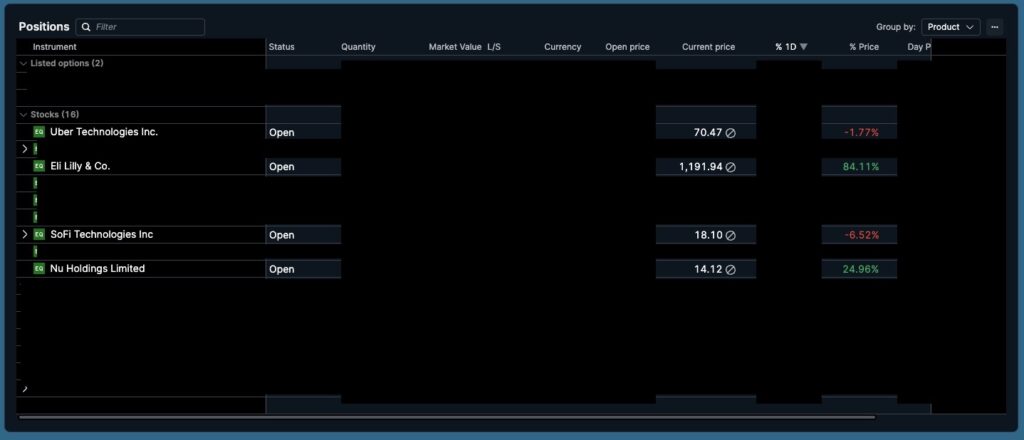
SoFi Technologies (SOFI). What stood out in my research was consistent earnings beats combined with genuine loan and user base growth, in a macro environment where most fintech companies are struggling to grow at all. When a company is expanding its customer base and beating expectations during a difficult period, that is worth paying attention to. The bear case is rate sensitivity and competition from traditional banks. The bull case is that they are building loyalty with a younger customer base before rates normalize.
Eli Lilly (LLY). My thesis here is straightforward. LLY is a US-based company competing directly with Novo Nordisk in the obesity drug market. Under the current administration, US-based pharmaceutical companies have a pricing advantage over foreign competitors in the domestic market that I do not think the market is fully pricing in. If LLY takes meaningful market share from NVO in the US, the revenue impact is significant given the size of the obesity treatment market.
Nu Holdings (NU). NU is one of the largest neobanks in Latin America and is actively pursuing a US banking license. The thesis is that they have already proven the model in a complex, high-friction banking environment and are now bringing that playbook to the US market. If they execute on the US license, the addressable market expands dramatically.
Uber (UBER). The market is more skeptical about autonomous driving than I am, and I think that skepticism is creating an opportunity. My view is that Uber is becoming a super app, not just a ride-hailing company, with growing revenue across freight, delivery, and advertising. The declining stock price against improving fundamentals is the kind of setup I look for when the AI research surfaces a gap between what the market believes and what the numbers suggest.
These are positions I hold personally. This is not a recommendation to buy any of these stocks. Do your own research before making any investment decision.
The one thing that matters more than any tool
After testing many AI tools for investing beginners over the past year, the most important insight is not about any specific tool. The most valuable thing AI can do for a beginning investor is not find you the next great stock. It is help you build the habit of asking structured questions before you commit money to anything.
Why does this company make money? What would have to be true for it to be worth significantly more in five years? What are the strongest arguments against owning it? What metrics would tell me I was wrong?
Those questions, asked consistently, matter more than any algorithm or signal. AI is a useful tool for working through them. It is not a substitute for doing the thinking.
Are you using any AI tools in your investing process? What has been most useful for you as a beginner? Drop it in the comments below. I read everything.